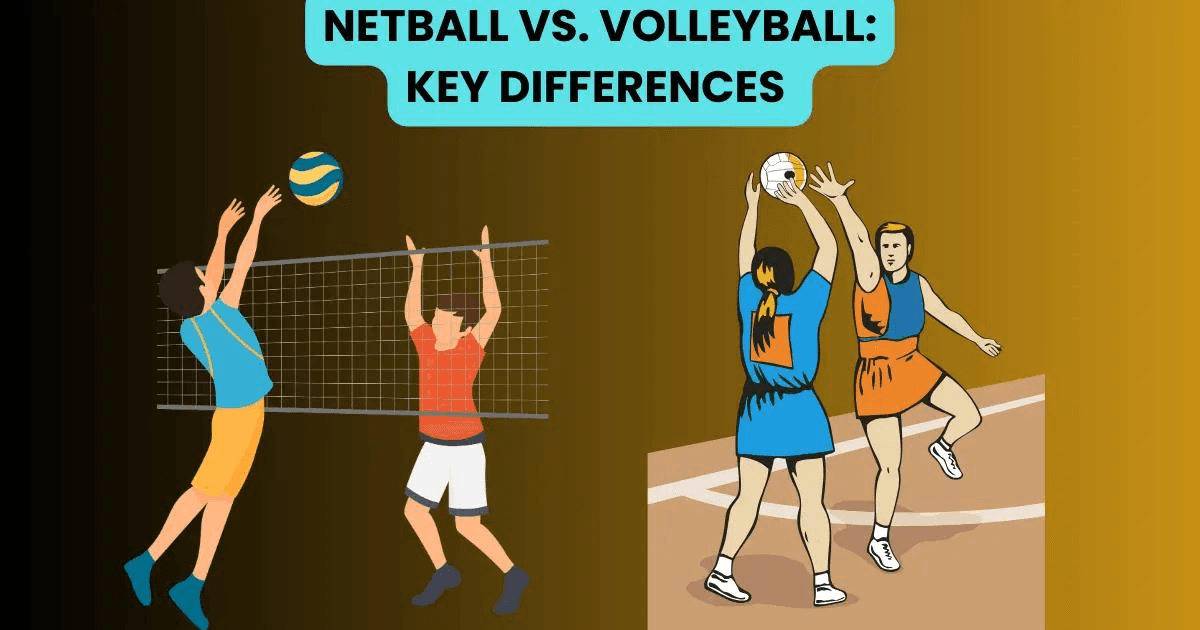
Netball vs Volleyball: 15 Key Differences Explained
Netball and volleyball are two popular team sports played around the world. Both require teamwork, coordination, communication and athletic ability. However, when comparing netball vs volleyball, the differences become clear in their rules, court layouts, player positions, scoring systems and playing techniques.
Netball is a fast-paced game in which players pass a ball between teammates and score by shooting through a raised ring. Volleyball is played across a net, with teams using controlled touches to send the ball into their opponents' court.
Although both sports involve passing and teamwork, they offer very different playing experiences.
In this guide, we explain 15 important differences between netball and volleyball to help you understand how each sport works.
Netball vs Volleyball: Quick Comparison
| Feature | Netball | Volleyball |
|---|---|---|
| Players on court | 7 per team | 6 per team |
| Court dimensions | 30.5 m × 15.25 m | 18 m × 9 m |
| Main objective | Shoot the ball through a ring | Send the ball over a net and land it in the opponent's court |
| Scoring method | Goals | Points |
| Match format | Four quarters | Best of five sets |
| Ball handling | Passing and catching | Hitting and striking |
| Ball possession | Limited by the three-second rule | The ball cannot be caught or held |
| Main equipment | Ball and goal rings | Ball and net |
| Player movement | Restricted by playing positions and footwork rules | Players rotate positions |
| Starting play | Centre pass | Serve |
| Governing body | World Netball | FIVB |
15 Major Differences Between Netball and Volleyball
1. Number of Players
One of the most noticeable differences between netball and volleyball is the number of players on the court.
Netball is played with seven players per team. Each player has a specific position and is responsible for particular areas of the court.
Volleyball is played with six players per team on the court. Players have different responsibilities in attack, defence, serving and setting.
2. Court Dimensions
The playing courts are different in size and layout.
A standard netball court measures 30.5 metres long and 15.25 metres wide. It is divided into three sections: two goal thirds and a centre third.
An indoor volleyball court measures 18 metres long and 9 metres wide. A net divides the court into two equal halves.
| Sport | Court Length | Court Width |
|---|---|---|
| Netball | 30.5 metres | 15.25 metres |
| Volleyball | 18 metres | 9 metres |
The netball court is considerably longer and wider than an indoor volleyball court.
3. Main Objective of the Game
The main objective of netball is to score goals by shooting the ball through the opponent's goal ring.
Players move the ball through passing and teamwork. Only the Goal Shooter and Goal Attack are permitted to score.
In volleyball, the objective is to send the ball over the net and make it land inside the opponent's court. Teams also try to prevent their opponents from returning the ball successfully.
4. Scoring System
Netball and volleyball use different scoring systems.
In netball, a team scores one goal when the ball passes completely through the goal ring from above.
In volleyball, teams earn a point after every rally, regardless of which team served. A standard indoor volleyball match is played in a best-of-five-sets format.
The first four sets are played to 25 points, while a deciding fifth set is played to 15 points. A team must win a set by at least two points.
5. Match Duration
Netball matches have a fixed playing format.
A standard international netball match consists of four 15-minute quarters, making 60 minutes of playing time. Breaks take place between quarters and at half-time.
Volleyball does not have a fixed match duration. The length of a match depends on how many sets are played and how closely contested the rallies are.
A volleyball match can finish in three sets or continue to a deciding fifth set.
6. Ball Handling Rules
Ball handling is another major difference between the two sports.
In netball, players can catch, hold and pass the ball. However, a player must release it within three seconds and follow the footwork rules.
In volleyball, players generally use their hands, arms and other permitted body parts to play the ball. They cannot catch or hold it.
A team can use a maximum of three hits to return the ball over the net, in addition to a block contact.
7. Player Positions
Netball has seven officially recognised playing positions:
- Goal Shooter (GS)
- Goal Attack (GA)
- Wing Attack (WA)
- Centre (C)
- Wing Defence (WD)
- Goal Defence (GD)
- Goal Keeper (GK)
Each position has specific responsibilities and permitted areas of the court.
Volleyball players have different tactical roles, including:
- Setter
- Outside Hitter
- Opposite Hitter
- Middle Blocker
- Libero
Unlike netball, volleyball players rotate around the court when their team wins the right to serve.
Learn more about Netball Positions and Their Roles.
8. Court Restrictions and Player Movement
Netball players cannot move freely across the entire court. Each position is restricted to specific areas.
For example, a Goal Shooter can play in the attacking third and attacking goal circle, while a Centre can move through all three thirds but cannot enter either goal circle.
Volleyball players can move around their side of the court according to the rules of the game. Their rotational order and front-row or back-row positions determine certain playing restrictions.
9. Starting the Game
Netball begins with a centre pass.
The Centre player takes the pass from the centre circle after the umpire's whistle. Teams alternate centre passes after each goal.
Volleyball begins with a serve. A player sends the ball over the net from behind the end line to start a rally.
The serving team changes when the receiving team wins a rally.
10. Equipment Used
Both sports require a ball, but their other equipment is different.
Netball uses a spherical ball and two raised goal rings positioned at opposite ends of the court. Players wear bibs displaying their position initials.
Volleyball uses a spherical ball and a net stretched across the centre of the court. Players wear team uniforms, and the libero usually wears a contrasting jersey.
11. Physical Contact
Netball has strict rules regarding physical contact and obstruction.
Players must defend without unfairly contacting opponents or interfering with their ability to play the ball. Defenders must also respect the required distance from a player holding the ball.
Volleyball generally involves less direct physical contact between opponents because a net separates the two teams. Players may still come into contact with teammates or the net during play, which is regulated by the rules.
12. Attacking Techniques
Netball attacking play focuses on passing, movement, creating space and accurate shooting.
Players work together to move the ball into the shooting circle, where the Goal Shooter or Goal Attack attempts to score.
Volleyball attacking play includes setting, spiking and tipping the ball over the net. Teams often use a sequence of passes to prepare an attacking shot.
13. Defensive Techniques
Netball defenders try to intercept passes, pressure opponents and prevent accurate shots.
Goal Defence and Goal Keeper are particularly important in defending the shooting circle.
Volleyball defence focuses on receiving serves, digging attacking shots and blocking spikes near the net.
Both sports require anticipation, positioning and communication to stop the opposition from scoring.
14. Substitutions and Team Rotation
Netball teams can make substitutions according to the competition rules and match conditions. Players usually remain in their assigned positions unless a substitution or positional change is made.
Volleyball uses a rotation system. When the receiving team wins the right to serve, its players rotate one position clockwise.
Volleyball also has specialist substitution rules, including those relating to the libero.
15. Governing Bodies
Netball and volleyball are managed by different international governing organisations.
World Netball is the international governing body responsible for developing and promoting netball worldwide. It also publishes the official international rules of the game.
The Fédération Internationale de Volleyball (FIVB) is the international governing body for volleyball. It oversees international competitions and publishes the official volleyball rules.
Official resources:
- World Netball – The Rules of Netball
- World Netball – Facilities and Equipment
- FIVB – Official Volleyball Rules
- FIVB – Basic Rules of Volleyball
Similarities Between Netball and Volleyball
Although netball and volleyball have many differences, they also share several important characteristics.
Teamwork
Both sports require players to communicate and work together. Individual talent is important, but successful teams depend on cooperation and coordination.
Passing Skills
Passing is essential in both games. Netball players pass the ball between teammates, while volleyball players use controlled touches to prepare attacks and return the ball.
Physical Fitness
Players need speed, stamina, balance, agility and coordination. Both sports involve quick reactions and repeated bursts of physical activity.
Team Strategy
Coaches develop attacking and defensive strategies to improve team performance. Players must understand their roles and make quick decisions during matches.
International Competitions
Both sports have international competitions and national teams representing countries around the world.
Which Sport Is More Difficult: Netball or Volleyball?
There is no single answer because both sports require different skills.
Netball can be challenging because players must follow strict positional restrictions, control their footwork, pass accurately and shoot under defensive pressure.
Volleyball requires excellent timing, jumping ability, coordination and ball control. Players must react quickly to serves, attacks and defensive movements.
The difficulty often depends on a player's experience, physical abilities and personal strengths.
Which Sport Is More Popular?
Volleyball has a larger international participation and audience footprint, with a particularly strong presence across Europe, Asia and the Americas.
Netball has a strong following in countries such as Australia, New Zealand, England, Jamaica, South Africa and other Commonwealth nations.
Both sports continue to develop through international competitions, grassroots programmes and professional opportunities.
Frequently Asked Questions
Is netball the same as volleyball?
No. Netball and volleyball are different sports with separate rules, court dimensions, player positions and scoring systems. Netball involves shooting through a goal ring, while volleyball involves sending the ball over a net.
How many players are in netball and volleyball?
Netball has seven players per team on the court, while indoor volleyball has six players per team.
Is a netball court bigger than a volleyball court?
Yes. A standard netball court measures 30.5 metres by 15.25 metres, while an indoor volleyball court measures 18 metres by 9 metres.
Can you use your feet in netball?
Netball is primarily played using the hands. Players are not permitted to deliberately kick the ball, although accidental contact with the foot is treated under the relevant playing rules.
Can you catch the ball in volleyball?
No. Players cannot catch or hold the ball during normal volleyball play. They must use legal contacts to keep it in play.
Which sport has more players?
Netball has seven players per team on the court, compared with six players per team in indoor volleyball.
How long is a netball match?
A standard international netball match consists of four 15-minute quarters, giving 60 minutes of playing time, excluding intervals and stoppages.
What is the main difference between netball and volleyball?
The biggest difference is how teams score. Netball players pass the ball and shoot through a raised ring, while volleyball players hit the ball over a net to land it in the opposing team's court.
Final Thoughts
Netball and volleyball are exciting team sports that require teamwork, skill, fitness and smart tactics. However, their playing styles and rules are very different.
Netball focuses on passing, positional play and accurate shooting, while volleyball depends on serving, setting, attacking and defending across a net.
Understanding these differences makes it easier to appreciate both sports and their unique challenges. Whether you enjoy the fast passing game of netball or the powerful rallies of volleyball, both offer exciting opportunities for players and fans.