Netball Positions and Roles: How to Play Netball
Netball is played by two teams of seven players, with every player assigned a specific position.
Each position has its own responsibilities and court restrictions. Understanding these positions helps players, coaches and supporters follow the game more effectively.
The seven positions are divided into attacking, centre and defensive roles.

What Are the Seven Netball Positions?
The seven positions in netball are:
- Goalkeeper (GK)
- Goal Defence (GD)
- Wing Defence (WD)
- Centre (C)
- Wing Attack (WA)
- Goal Attack (GA)
- Goal Shooter (GS)
Each player wears a bib displaying their position's abbreviation.
Netball Positions and Court Restrictions
| Position | Abbreviation | Permitted Court Areas |
|---|---|---|
| Goalkeeper | GK | Defensive third and defensive shooting circle |
| Goal Defence | GD | Defensive third, centre third and defensive shooting circle |
| Wing Defence | WD | Defensive third and centre third |
| Centre | C | All three thirds, excluding both shooting circles |
| Wing Attack | WA | Centre third and attacking third |
| Goal Attack | GA | Centre third, attacking third and attacking shooting circle |
| Goal Shooter | GS | Attacking third and attacking shooting circle |
1. Goalkeeper (GK)
The Goalkeeper is responsible for defending the team's goalpost.
The GK operates in the defensive third and shooting circle.
Main responsibilities include:
- Defending against the opposing Goal Shooter.
- Blocking and contesting shots.
- Intercepting passes.
- Rebounding missed shots.
- Supporting defensive teammates.
2. Goal Defence (GD)
The Goal Defence works alongside the Goalkeeper to prevent the opposition from scoring.
The GD can move through the defensive third and centre third, including the defensive shooting circle.
Main responsibilities include:
- Marking the opposing Goal Attack.
- Intercepting passes.
- Applying pressure to attackers.
- Supporting defensive rebounds.
- Helping move the ball towards the attacking end.
3. Wing Defence (WD)
The Wing Defence is responsible for disrupting the opposition's attacking movements.
The WD can play in the defensive and centre thirds but cannot enter either shooting circle.
Main responsibilities include:
- Marking the opposing Wing Attack.
- Preventing easy passes.
- Creating interceptions.
- Supporting the Centre.
- Helping transition the ball into attack.
4. Centre (C)
The Centre is one of the most important positions in netball.
The Centre can move through all three court thirds but cannot enter either shooting circle.
Main responsibilities include:
- Taking centre passes.
- Connecting defence and attack.
- Distributing the ball.
- Supporting teammates.
- Maintaining possession.
The Centre often plays a key role in controlling the team's movement and passing rhythm.
5. Wing Attack (WA)
The Wing Attack is responsible for creating attacking opportunities.
The WA operates in the centre and attacking thirds but cannot enter the shooting circle.
Main responsibilities include:
- Receiving centre passes.
- Feeding the ball to shooters.
- Creating space.
- Supporting the Goal Attack and Goal Shooter.
- Delivering accurate passes.
6. Goal Attack (GA)
The Goal Attack combines attacking and shooting responsibilities.
The GA can move through the centre and attacking thirds, including the attacking shooting circle.
Main responsibilities include:
- Creating shooting opportunities.
- Scoring goals.
- Feeding the Goal Shooter.
- Supporting the Wing Attack.
- Maintaining attacking pressure.
7. Goal Shooter (GS)
The Goal Shooter is primarily responsible for scoring goals.
The GS is restricted to the attacking third and shooting circle.
Main responsibilities include:
- Shooting goals.
- Maintaining accurate shooting technique.
- Creating space inside the circle.
- Receiving passes from teammates.
- Rebounding missed shots.
How Do Netball Players Work Together?
Netball requires all seven players to work as a coordinated unit.
Attacking players create scoring opportunities, while defensive players attempt to stop the opposition.
The Centre connects both sides of the court and helps maintain possession.
Communication, timing and accurate passing are essential for successful teamwork.
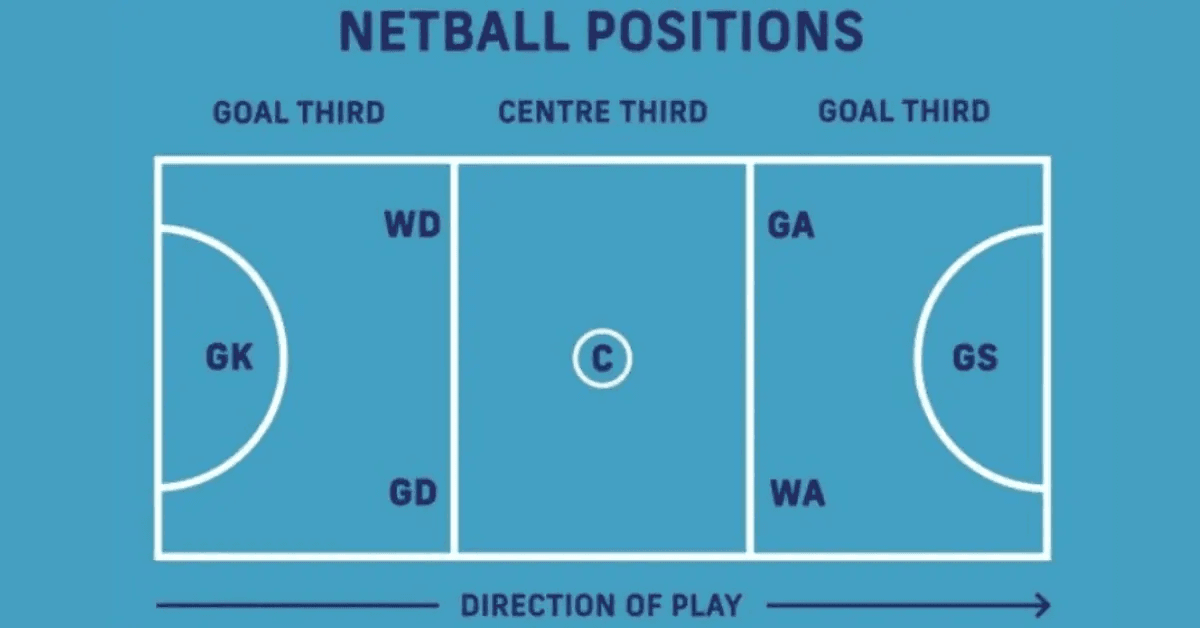
Netball Positions Diagram
The following image shows the seven positions and their general court areas.
Why Are Netball Positions Important?
Position restrictions ensure that players have specific responsibilities during the match.
They also encourage teamwork because players must pass the ball between teammates to move it around the court.
Understanding positions makes it easier to learn the rules and develop effective playing strategies.
For additional guidance, read our Ultimate Guide to Netball Rules.
Frequently Asked Questions
How many positions are there in netball?
There are seven positions in standard netball.
Which netball position scores goals?
The Goal Shooter and Goal Attack are the two positions permitted to shoot at goal.
Which position can move across the whole court?
The Centre can move through all three court thirds but cannot enter either shooting circle.
Can the Goalkeeper enter the centre third?
No. The Goalkeeper is restricted to the defensive third and defensive shooting circle.
Which position takes the centre pass?
The Centre takes the centre pass to restart play after a goal.
Final Thoughts
Every netball position plays an important role in the success of a team.
From the Goalkeeper's defensive responsibilities to the Goal Shooter's scoring duties, all seven positions contribute to the team's overall performance.